

 ท่อน
ท่อน 
For flooring distributors, project specifiers, and retail buyers, the choice between solid wood and engineered wood flooring is one of the most consequential product decisions you will make. Both are genuine hardwood products. Both deliver the warmth, character, and prestige that wood flooring commands in the market. But they are engineered for fundamentally different performance conditions — and matching the right product to the right market is what separates successful flooring businesses from those that face costly returns and dissatisfied clients.
This guide cuts through the surface-level comparisons to give you the technical and commercial clarity you need to source and recommend with confidence.
Understanding the Construction Difference
Solid wood flooring is exactly what the name describes: each plank is milled from a single, continuous piece of hardwood, typically 18mm to 20mm thick. There are no adhesives, no layers, no composite cores. The entire plank — top to bottom — is the same species. This gives solid wood its characteristic density underfoot, its acoustic properties, and its ability to be sanded back and refinished repeatedly over decades.
Engineered wood flooring, by contrast, is a layered construction. A top layer of real hardwood veneer — the wear layer — is bonded to a multi-ply core, typically made from cross-banded birch plywood or high-density fiberboard. The cross-banded arrangement is the structural key: each layer runs perpendicular to the one above and below it. This opposing grain direction neutralizes the natural tendency of wood to expand and contract with changes in humidity and temperature, producing a plank that is dimensionally far more stable than a solid board of the same species.
Both products use 100% real hardwood on their surface. The visual result — grain, texture, species character — is identical. The difference lies entirely in how each product behaves beneath that surface, and under what environmental conditions each will perform reliably over time.
Stability and Moisture Resistance
Dimensional stability is the single most important technical differentiator between the two product types, and it is the factor that most often determines which product is appropriate for a given market or installation environment.
Solid hardwood is a natural, hygroscopic material — it absorbs and releases moisture from the surrounding air. As humidity rises, solid planks swell laterally. As humidity drops, they contract, sometimes leaving visible gaps between boards. In climates with stable indoor humidity (typically between 40–60% RH year-round), solid wood performs beautifully and predictably. In markets with significant seasonal humidity swings, coastal climates, or spaces with variable temperature control, solid wood requires careful acclimation, proper expansion gaps, and ongoing humidity management by the end user.
Engineered flooring's multi-ply core dramatically reduces this movement. The cross-banded construction resists expansion and contraction across the plank width, making it suitable for installation in environments where solid wood would struggle: over radiant underfloor heating systems, directly on concrete subfloors, in below-grade spaces such as basements, and in regions with tropical or highly variable climates. For export-oriented businesses supplying markets in Southeast Asia, the Middle East, or coastal Europe, engineered flooring is almost always the technically correct choice.
Wear Layer, Refinishing, and Lifespan
One of the most misunderstood aspects of engineered flooring is the wear layer — the top hardwood veneer that determines how long the floor can be maintained and refinished. Wear layer thickness varies considerably across the market, and understanding this specification is critical for buyers sourcing products for different end-use segments.
| Wear Layer Thickness | Refinishing Potential | Estimated Lifespan | Best Application |
|---|---|---|---|
| 1–2mm | Light sand only, 0–1 times | 15–25 years | Budget residential, rental |
| 3mm | 1–2 full refinishes | 25–40 years | Mid-range residential |
| 4mm+ | 3–4 full refinishes | 40–60+ years | Premium residential, commercial |
| Solid (18–20mm) | 4–6 full refinishes | 50–100+ years | Heritage, luxury, long-hold projects |
For buyers targeting the premium residential or commercial segment, specifying engineered products with a 4mm or thicker wear layer closes most of the longevity gap with solid wood. Our HDF engineered wood flooring range uses a high-density fiberboard core with a substantial hardwood veneer, delivering structural rigidity and surface durability well-suited to high-traffic environments. For clients who prioritize the ability to refinish and restore a floor across multiple renovation cycles, solid wood remains the longest-term investment.
Installation Methods and Subfloor Compatibility
Installation flexibility is an area where engineered flooring holds a clear practical advantage, particularly for contractors working across diverse project types.
Solid wood flooring is installed by nailing or stapling directly into a timber subfloor. It cannot be glued to concrete without additional preparation, cannot be floated, and cannot be installed in below-grade spaces. Any solid wood installation over 5 inches wide will also require gluing in addition to nailing, increasing labor costs. These constraints are manageable in markets with predominantly timber-framed residential construction, but they limit solid wood's applicability in commercial projects, apartment buildings, and renovation work over existing concrete slabs.
Engineered flooring supports all three primary installation methods:
- Nail or staple down — onto timber subfloors, identical to solid wood installation.
- Glue down — directly onto concrete slabs or existing tile, with no subfloor conversion required.
- Floating — click or tongue-and-groove planks laid over an underlay, with no fastening required; ideal for DIY-friendly markets and renovation projects.
This installation versatility means engineered flooring can be specified across a far broader range of project types — from new-build apartments on concrete decks to retail refits and hospitality renovations — without the contractor needing to modify the existing subfloor structure.
Design Options: Formats, Species, and Finishes
Both product types are available across a wide range of species — White Oak, Black Walnut, Birch, Ash, and more — but engineered flooring's dimensional stability unlocks design formats that are impractical or impossible to achieve in solid wood at scale.
Because engineered planks do not move significantly with humidity changes, manufacturers can produce them in wider and longer formats without the warping or cupping risk that affects wide solid boards. This makes engineered flooring the natural choice for the wide-plank aesthetic that dominates contemporary interior design. Beyond standard plank formats, engineered construction enables the full range of parquet patterns:
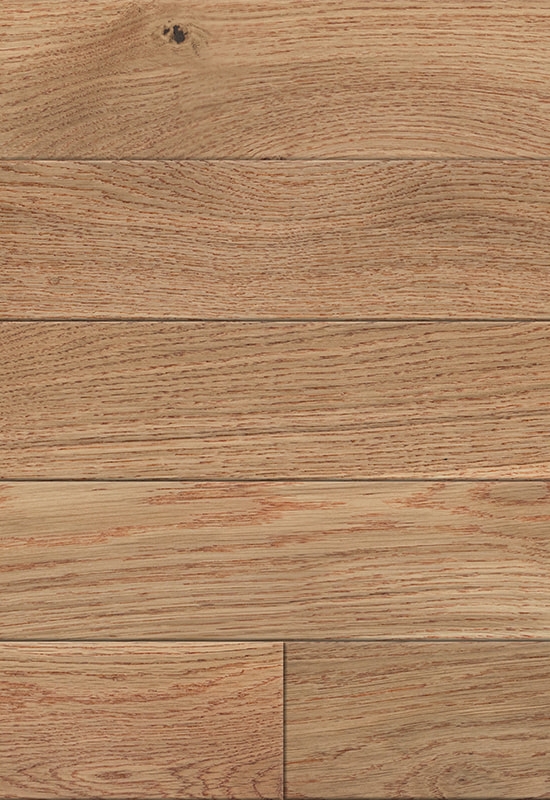
- Plank — the standard long-board format in various widths, from narrow traditional profiles to ultra-wide contemporary planks.
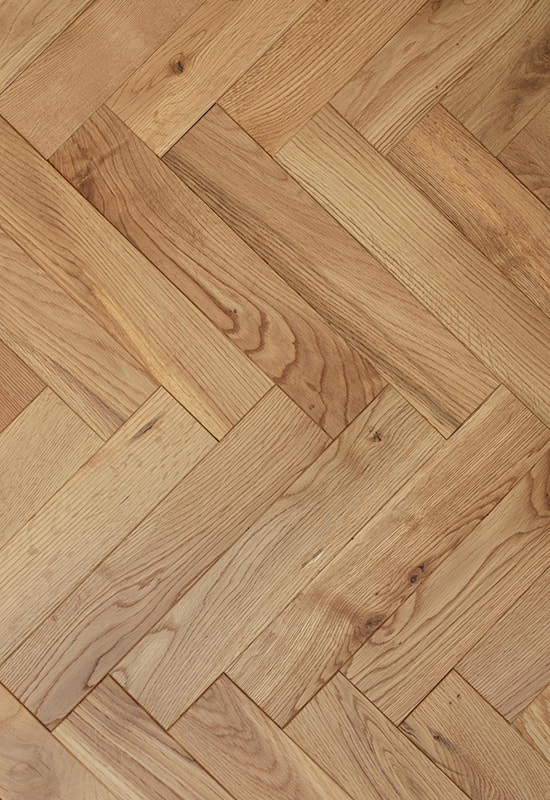
- Herringbone — the classic V-shaped interlocking pattern derived from European parquet tradition; commanding strong demand in luxury residential and hospitality projects.
- Chevron — similar to herringbone but with angled plank ends that meet in a continuous arrow point; a sharper, more contemporary aesthetic increasingly specified by interior designers.
- Design parquet — geometric configurations including basket weave, Versailles, and custom mosaic patterns for feature spaces and bespoke installations.
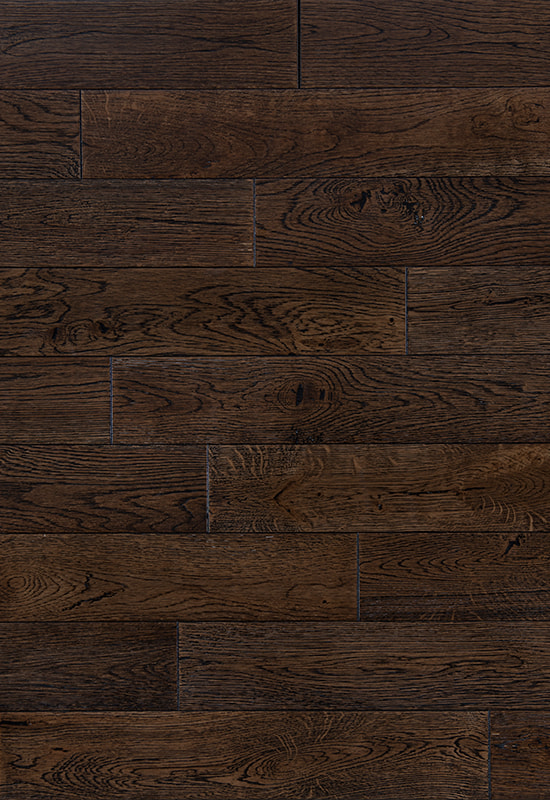
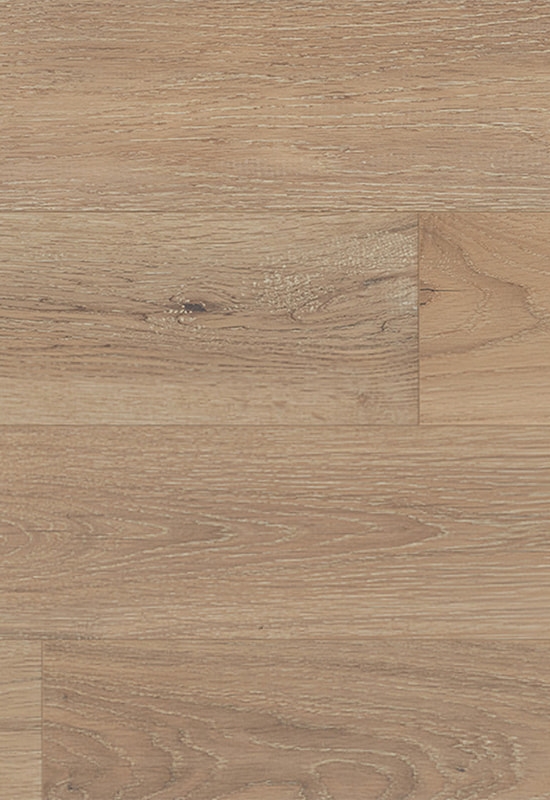
Surface treatments further expand the specification palette. Both product types are available in flat/smooth, wire-brushed, hand-scraped, carbonized, white-washed, and chemically aged finishes — allowing precise matching to a client's target interior style, from Scandinavian minimal to reclaimed rustic.
Cost Comparison and Long-Term Value
On a per-square-meter basis, entry-to-mid-range engineered flooring is generally priced below comparable solid wood. However, the picture shifts meaningfully at the premium end: high-specification engineered products with thick wear layers, premium plywood cores, and wide-format planks are priced comparably to, and sometimes above, solid wood in the same species.
For B2B buyers, the more useful lens is total cost of ownership across the product's installed life:
- Solid wood carries a higher upfront material and labor cost but can be refinished 4–6 times over its lifespan, potentially delivering 80–100 years of service before replacement. For long-hold property investors and heritage renovation clients, this calculus strongly favors solid wood.
- Engineered flooring offers lower initial cost, faster installation (especially for floating formats), and eliminates the subfloor preparation expense often required for solid wood on concrete. For commercial operators, developers targeting a 10–20 year asset cycle, and rental property owners, engineered flooring typically delivers superior financial returns.
The key sourcing variable for engineered products is wear layer specification. Buyers who default to the thinnest and cheapest wear layers to win price-sensitive tenders often create long-term reputation risk when end users find their floors cannot be refinished after 10 years. Specifying a minimum 3mm wear layer — and ideally 4mm for any premium positioning — is the baseline for a commercially sustainable product offer.
Choosing the Right Product for Your Market
The most effective way to translate this technical knowledge into commercial decisions is to map each product type against the specific conditions of your target market. Below is a practical framework for that assessment:
| Market Condition | Recommended Product | Key Reason |
|---|---|---|
| Stable continental climate, timber-frame residential | Solid Wood | Low humidity variation; nailed installation standard |
| Tropical, coastal, or highly seasonal climate | Engineered Wood | Cross-ply core resists swelling and contraction |
| Apartment / concrete slab subfloors | Engineered Wood | Glue-down and floating installation compatible |
| Radiant underfloor heating systems | Engineered Wood | Greater thermal stability; solid wood may crack over heat |
| Luxury residential, heritage renovation | Solid Wood or Premium Engineered (4mm+ wear layer) | Maximum refinishing potential; long asset life |
| Commercial / hospitality / high-traffic | Engineered Wood (HDF or multi-ply core, 4mm+ wear) | Dimensional stability under heavy use and varied conditions |
| Design-led projects (herringbone, chevron, wide plank) | Engineered Wood | Pattern formats and wide planks require dimensional stability |
Geography matters as much as use case. Markets in Northern Europe, where timber-frame construction dominates and indoor climates are tightly controlled, show strong solid wood adoption. Markets across Southeast Asia, the Gulf region, and much of South America — where humidity is high, concrete construction is standard, and air conditioning creates sharp daily humidity swings — are natural engineered flooring markets. Understanding the climate and construction norms of your end destination is as important as understanding the product itself.
Explore Our Solid and Engineered Flooring Collections
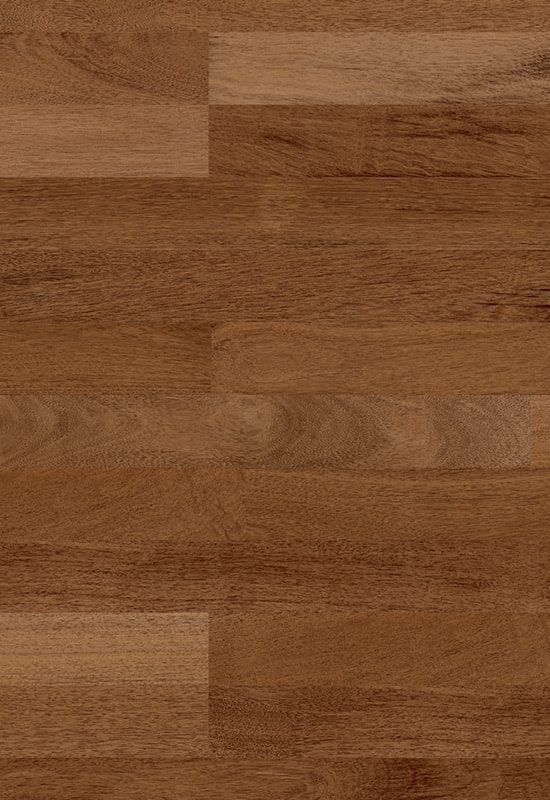
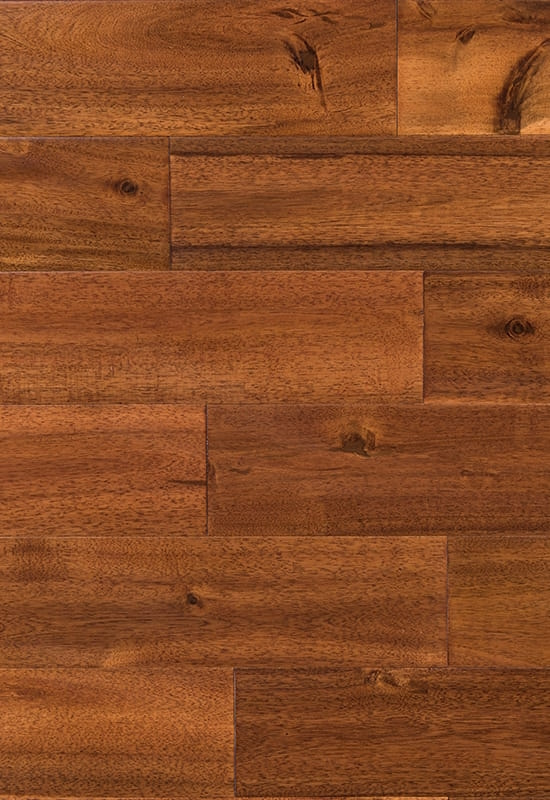
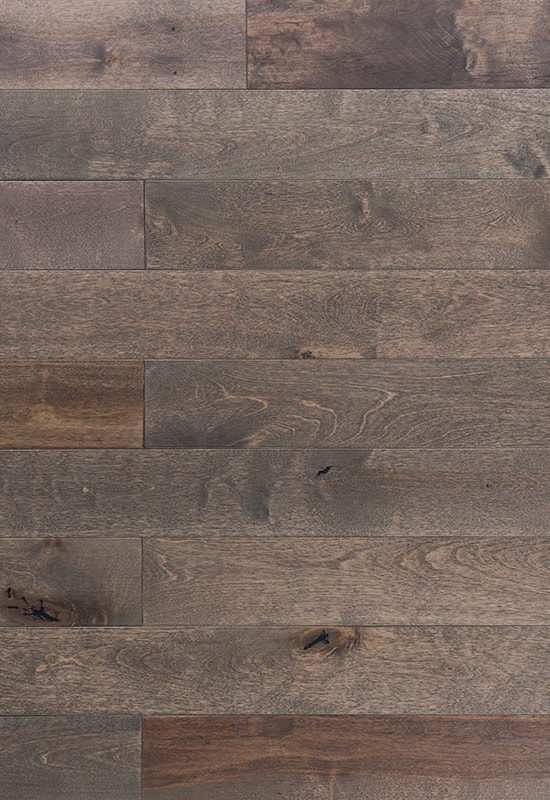
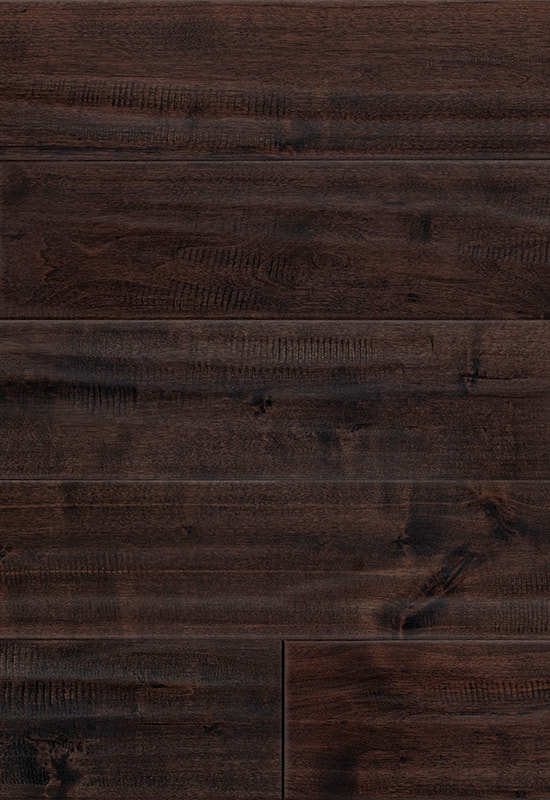
At Jesonwood, we manufacture both solid and engineered wood flooring across a full range of premium species, surface treatments, and format options — from traditional plank profiles to herringbone, chevron, and bespoke design parquet. Our production facility is built for B2B supply at scale, with consistent quality standards and the flexibility to accommodate custom specifications across wear layer thickness, plank dimensions, species, and finish.
Whether you are building a flooring range for a regional distribution network, sourcing for a large commercial project, or developing a private-label collection, our team can work with you to identify the right product configuration for your market's specific performance and aesthetic requirements.
Explore our full collections of solid wood flooring and engineered wood flooring, or contact us directly to discuss specifications and sampling.

 +86-572-2118015
 No.598 Gaoxin Road, เขตอุตสาหกรรม Huanzhu, เมือง Huzhou, มณฑลเจ้อเจียง, จีน, 313000